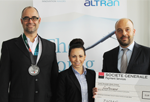

Michael Blickle will however continue his position as chairman of the boards and thus is significantly involved in Altran Deutschland’s strategic orientation. The editors talked with Cosimo De Carlo about his start as CEO, Altran's strategy and future markets.
Mr De Carlo, starting with Altran as a Consultant you learned the business from scratch since changing from Daimler to Altran in 2001. On 1 January 2014 you became the CEO of Altran Deutschland.
What are your goals for the first 100 days?
Unfortunately, there is no such thing as the "first 100 days" in technology consulting. Already in the first week fast decisions had to be made: We are presently merging IndustrieHansa - a company which Altran took over in 2013 and which I have been heading since September 2013 as CEO - with Altran's portfolio. Both enterprises have different strong points. The takeover aims at offering services which provide our customers with more added value in the design of their technical innovations. We are working intensively on the integration of Altran and IndustrieHansa in Germany, Eastern Europe and China at full speed and we are already seeing the fruits by way of synergies. Here we really feel how one and one make three - in fact, no less than two, as can be perceived in the cases of various integration processes in the market. A number of teams from both companies are already cooperating very successfully in the course of projects in the fields of aerospace, space, automotive and energy.
Is this how you are preparing for the changes in the industry?
Yes indeed. Permanent enhancement and adjustment of our own company to an ever changing environment is a matter of course - in this world of continuous change, enterprises virtually never reach the end. In particular, in the automotive industry this is a fact: Those who are in a state of inertia for three or four months will soon be overtaken by their competitors. Moreover, the engineering business is becoming more international as all its customers increasingly act at a global level. With this acquisition we have reached the mark of 21,000 employees worldwide, thus setting ourselves apart from our competitors even more clearly.
What are the major topics for Altran this year?
It is thrilling to see how the fields involved in engineering in different industries are increasingly merging: A vivid example is the connectivity of vehicles, machines and technologies. Connectivity has its origins in the field of telecommunications; now it is one of the major drivers in the automotive industry. Take the energy sector, where complete energy flows within cities can be controlled by intelligently combining producers, users and possible energy stores. In the field of aerospace we are integrating connectivity in commercial aircraft, for instance, to reduce waiting times or to learn more about the passengers' personal preferences so that they can be attended to on the plane more individually.
Which further future topics do you see?
In the automotive industry electro-mobility will continue to accompany us in all its variations as will the issue of "autonomous driving". Apart from these technical innovations there is a trend towards individual adjustment, to so-called "customisation": Cars as well as civil or private aircraft will be more and more individually equipped. This will strengthen the corresponding OEM brand or the airline and tie target groups more strongly to the company. But this trend towards customisation also raises the need for individual design and consequently the demand for our services.
What significance does speed have in technology transfer?
The speed in the transfer of technologies is clearly gaining importance because development cycles as such are getting shorter. Further challenges are presented by the different development pace of the industries: Telecommunications and IT develop considerably faster than the automotive or aerospace industries or even the energy sector. It is now all about continuously merging and integrating the technologies in spite of their varying development pace.
What does this depend on?
Merging or "integrating" technologies is one of the major challenges. After all, you have to be able to thoroughly manage the technologies and, at the same time, develop and implement solutions for their integration. Uniform standards are essential in order to avoid starting from scratch all the time. For this reason we cooperate with standardisation committees on drafting standards, e.g. for interfaces - this is beneficial for us but also for other market participators. Modular and extendable design concepts also play a role which, just like modular systems, reduce long integration phases and save development costs.
What will Altran's strategic focus be in the future?
The consolidation phase in our industry is still in full swing. Size is more important than ever, as service providers take on more and more responsibility and need to be increasingly efficient. The reason is the trend for manufacturers to transfer ever larger research and development budgets to their suppliers because of the rising diversity of their product portfolios. For this purpose a certain company size is necessary to be able to mitigate risks and to manage complexity.
Which aims do you pursue with this strategy?
Altran wants to continue assuming responsibility for technological development and therefore focuses on the topics mentioned earlier, such as connectivity, future mobility and complex technologies, but also on interdisciplinary solutions such as Product Lifecycle Management or Intelligent Systems. The secret of our industry is always playing a pioneering role. Supply of "commodities", i.e. replaceable technologies, is no longer a unique characteristic, and technologies still considered innovative a few years ago have become everyday issues. It is our claim to be in charge of leading-edge technology: Innovation is in our genes.
What are the issues that will dominate Altran's automotive business this year and can other industries benefit from the findings?
The ongoing demand for infotainment in aircraft and vehicles opens up new possibilities for the turnover growth telecommunications providers urgently need. I don't only mean pure data services in cars but complete platforms of mobility services. Soon it will be normal to drive a car and be permanently connected to the Internet. Furthermore, in Western countries there is a trend among younger people to rather do without their own cars than their own smart phones. For this reason some premium manufacturers are experimenting with new business models as mobility service providers. For those developments, Altran must also have a solution ready.
Emerging countries are gradually turning into industrialised countries - first and foremost China.
How does this change the demands made on car manufacturers? Do you notice that products designed for individual countries already have to be increasingly adapted?
A presence in China is a must for every larger manufacturer or service provider because it is what the market demands. The number of development projects there is continuously increasing. Altran has been present in this market for years. Moreover, we set up two joint ventures in 2013 and 2014: Altran-Beyondsoft (Beijing) Technologies Co., Ltd. and Altran Automotive Technology (Shanghai), both aimed at deploying our know-how effectively in the Chinese market.
Furthermore, some Chinese car manufacturers have decided to target the European market. We consider this additional competition as a chance for European car manufacturers to improve their own cars. In addition, OEMs must become more efficient and more innovative in future. After all, German innovative power is still a criterion of distinction from the rest of the world. German car manufacturers still have the best chances to gain further market shares in China, in particular with cars with individual and technologically sophisticated equipment.